Story 05 · Upper Tywi valley, Carmarthenshire and Ceredigion
The tallest dam
Llyn Brianne took in far fewer homes than the other reservoirs in these stories. It is the story of a valley that fought a dam, lost, and then lived beside a rock-fill wall that is said to be the tallest in the UK.
Chapter 1 · The 1960s
The search for a site
In the early 1960s the local authorities of West Glamorgan needed a new reservoir. They first looked at the Gwendraith Fach valley, near Porthyrhyd and Llangyndeyrn, but local resistance made them drop those plans. The Upper Tywi came next. It was a remote valley of hill farms, forestry and oak woods, and few people lived there.
The water was meant for the Swansea area, and the plan was to let the River Tywi itself carry it south, rather than pipes.
Chapter 2 · 1965 to 1967
The fight
Public meetings were held in Rhandirmwyn in 1965, and a defence committee was formed after one on 22 September. Emlyn Jones was chair and Dafydd Dafis was secretary. They hired lawyers, but they had little money, and that limited how long the inquiry could run and how many experts they could call. Conservation groups, including the RSPB, the Botanical Society, the West Wales Naturalists’ Trust and the Council for the Preservation of Rural Wales, also opposed the scheme.
The West Glamorgan Water Board was formed on 1 October 1966 and applied for the scheme. A public inquiry sat at the Castle Hotel in Llandovery from 13 December 1966 to 9 February 1967. The inspector reported to the Welsh Secretary that June. Opponents did not see the report until December 1967, when they learned that permission had been granted.
- 22 Sep 1965A meeting at Rhandirmwyn leads to a defence committee.
- 1 Oct 1966The West Glamorgan Water Board is formed.
- Dec 1966 to Feb 1967The public inquiry sits in Llandovery.
- Dec 1967Opponents learn permission has been granted.
- Oct 1968Construction begins.
Chapter 3 · 1968 to 1972
The dam
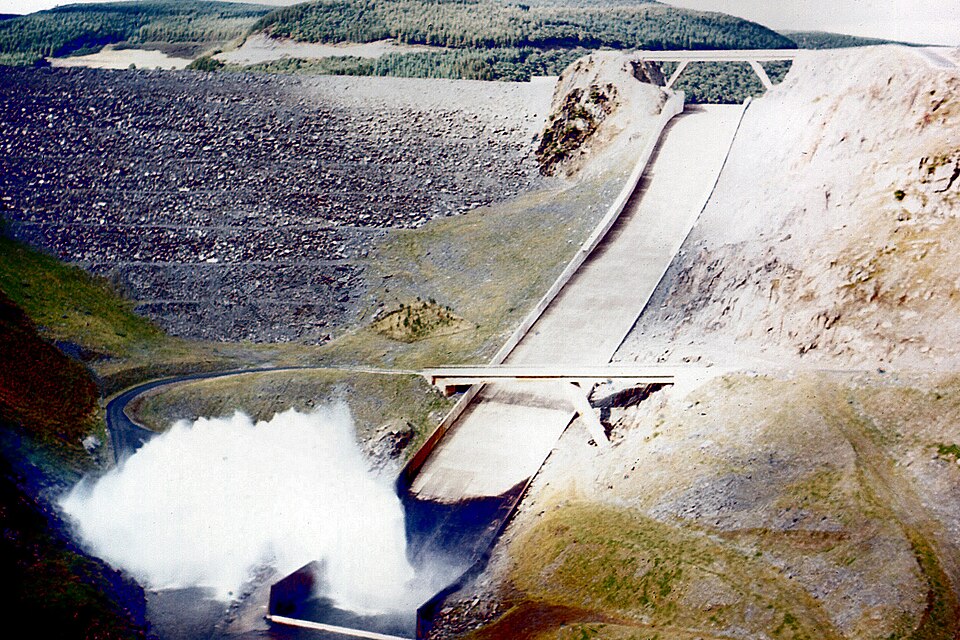
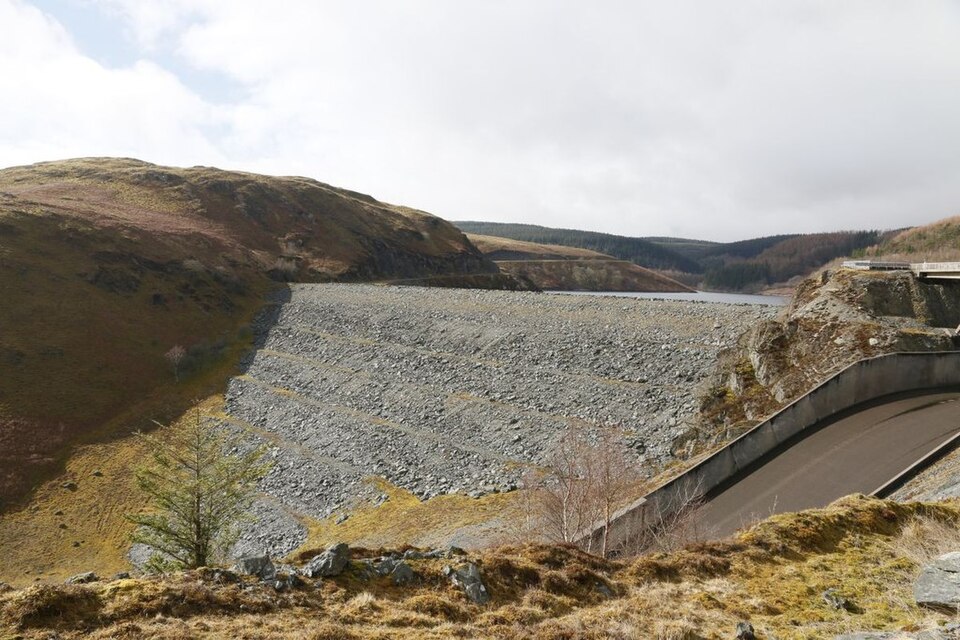
George Wimpey built the dam, with Binnie and Partners as the engineers. Work began in October 1968. The dam is a pile of rock with a tapering clay core, a type of dam in which the stone for the wall was cut from the hillside nearby, partly from the cutting for the spillway. The dam reached its full height in November 1971, and it was plugged in February 1972. The first water came in October 1972.
Chapter 4 · 1973
Opened
Princess Alexandra opened the scheme on 15 May 1973. Its job is not to feed a pipe. Llyn Brianne holds winter rain and releases it so that the Tywi stays full in dry weather, which allows a large amount of water to be taken out about 40 miles downstream at Nantgaredig, near Carmarthen. From there it was pumped to the Lliw Isaf reservoir near Felindre, outside Swansea.
The tinplate works at Felindre and a smelting plant at Llansamlet were the heavy industry the scheme was built for. Both have closed, and the water that Swansea no longer needs now goes into the wider supply, to Llanelli and across south Wales.
The name is a small puzzle. It comes from a nearby stream, Nant y Bryniau, and was said to be unfamiliar to the people who lived there.
Chapter 5 · 1995 to today
The lake today
In 1995 and 1996 the spillway and crest were raised by a metre, which added about 6 per cent to the capacity. A hydroelectric station with three turbines, which opened on 15 January 1997, generates up to 4.3 megawatts at the foot of the dam.
The power line gave the valley one more fight. The first plan was to carry the electricity to the grid on pylons down the Tywi valley, but residents and visitors objected, and the cable was buried beside the road to Llandovery instead.
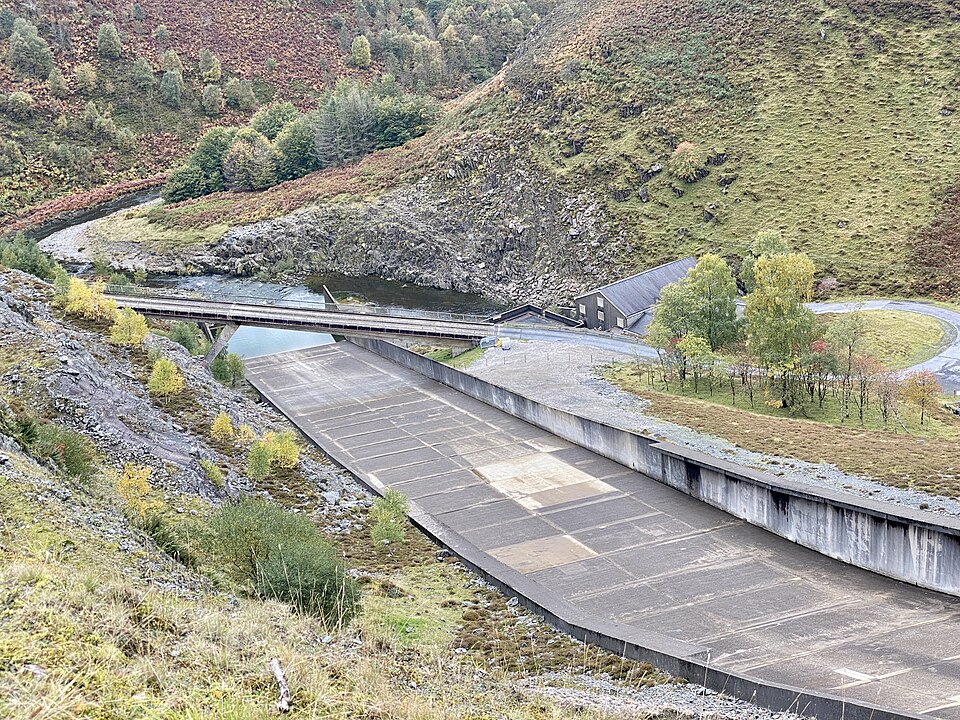
For about twenty years kayakers ran the spillway, a drop of around 300 feet, until it was banned. The reservoir has been governed by bylaws since 19 April 2011.
Sources and credits
Photographs are credited. Where sources disagree we say so above.
- Dafydd Dafis, The Llyn Brianne Water Scheme (rhandirmwyn.net)
- Engineering Timelines, Llyn Brianne Dam
- Cil-y-cwm community site, Little Switzerland
- Wikipedia, Llyn Brianne; River Towy; Reservoirs of Wales
- Monmouthshire Beacon, Llyn Brianne: the reservoir with a strange history
- See Around Britain, Llyn Brianne
Photographs
- The dam and spillway, September 1975: Peter Jeffery, via Geograph and Wikimedia Commons, CC BY-SA 2.0.
- The rock-fill face, 2015: Bill Nicholls, via Geograph and Wikimedia Commons, CC BY-SA 2.0.
- The spillway, October 2022: Alan Hughes, via Geograph and Wikimedia Commons, CC BY-SA 2.0.