Story 02 · Vyrnwy valley, Powys
The village that moved
In 1880 Parliament let Liverpool dam the Vyrnwy valley. The village of Llanwddyn was pulled down, rebuilt two miles away, and the old one went under the lake.
Chapter 1 · Before 1877
The valley
Llanwddyn lay at the head of the Vyrnwy valley in Montgomeryshire, in the hills of what is now Powys. By the middle of the 19th century the village had 37 houses, a church, two chapels, three pubs and several shops. It was a farming parish, and it was shrinking: its population fell from 668 in 1831 to 443 in 1871.
The parish church was dedicated to St John the Baptist. In the 13th century the manor had passed to the Knights Hospitallers of St John, who built a stone church there. A new vicar, appointed in 1870, collected a great deal of local history, and the Reverend Thomas H. Evans published his findings in 1873. It is largely thanks to that record that we know what the valley was like before the lake.
Chapter 2 · 1877 to 1880
The decision
In the summer of 1877 George Deacon, Liverpool’s city engineer, came to Llanwddyn to see whether the Vyrnwy could be dammed below the village to make a very large reservoir. Liverpool was growing fast and needed more water. Deacon reported to the Corporation on 27 November that year.
A parliamentary bill was drawn up. The people of Llanwddyn were not consulted, though they signed a petition against it. The Liverpool Corporation Waterworks Act passed in 1880 and received the Royal Assent on 6 August. Thomas Hawksley was appointed engineer in chief and designed a stone dam.
- 1873The Reverend Thomas H. Evans publishes his findings on the parish.
- Summer 1877George Deacon arrives in Llanwddyn to look at the valley.
- 27 Nov 1877Deacon reports to Liverpool Corporation.
- 6 Aug 1880The Liverpool Corporation Waterworks Act receives the Royal Assent.
- 14 Jul 1881Construction is officially begun. A commemorative stone records the day.
Chapter 3 · 1881 to 1888
The dam
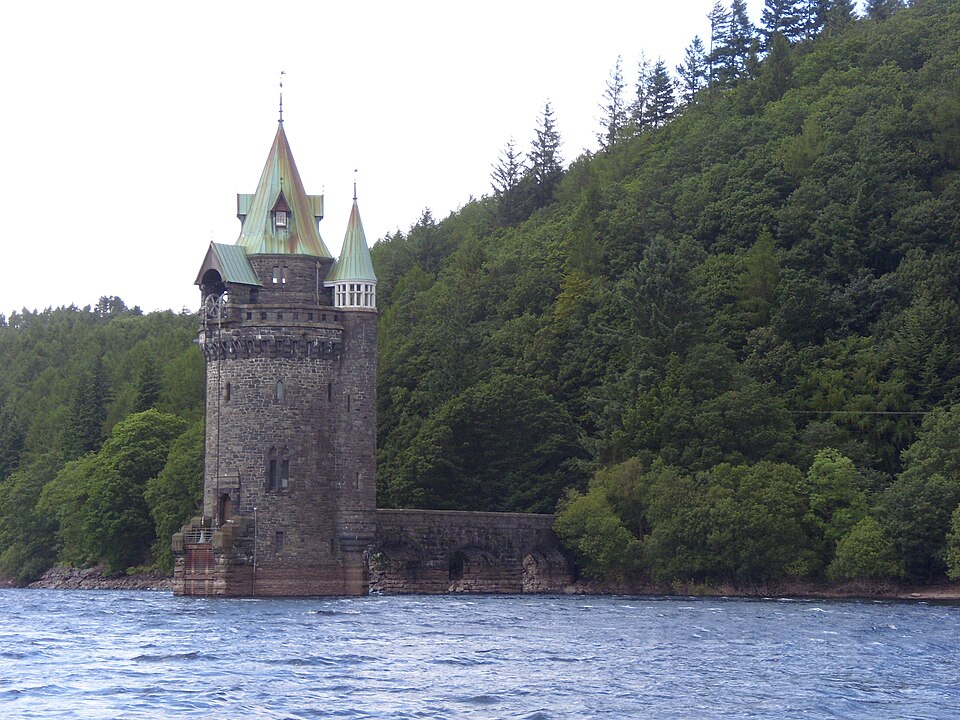
The dam was the first large masonry dam in Britain. Work began in 1881 and the lake it made was, when finished, the largest reservoir in Europe. The wall is about 358 metres long. Engineers worked on the scheme for years: Hawksley left the project in 1885, and Deacon took charge. Deacon also designed the Gothic straining tower that stands in the lake.
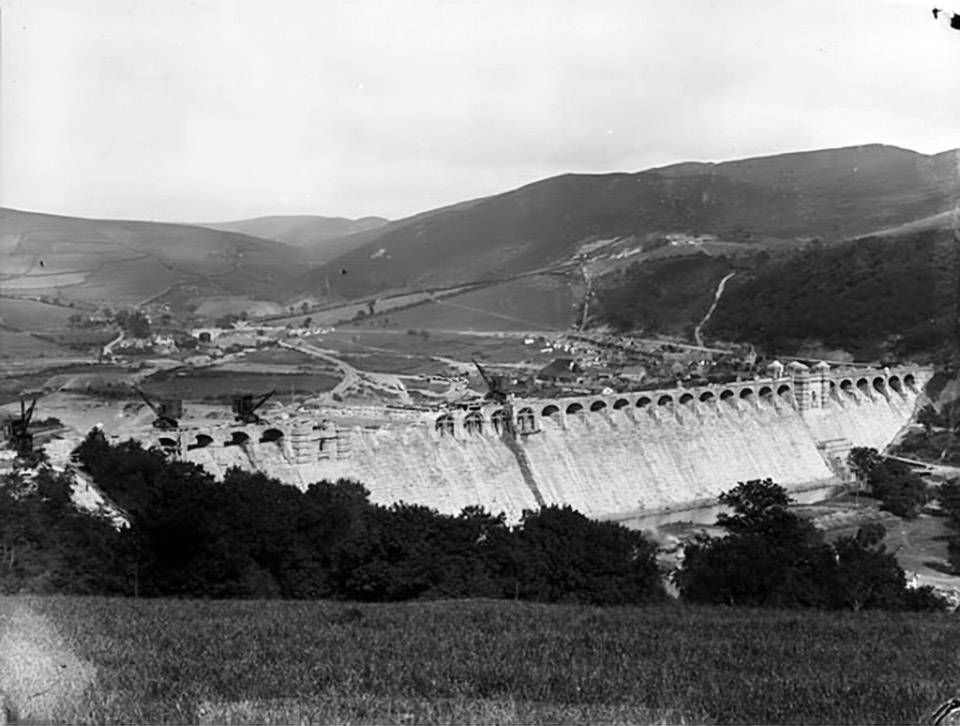
At the height of the work about a thousand men were employed. A map of 1891 shows the dam still under construction, surrounded by quarries, tramways, workshops and workers’ housing. Forty-four men died during the building of the dam and the reservoir works. Ten were killed in accidents on the site and 34 died of other causes. Their fellow workmen put up a memorial obelisk with their names.
Chapter 4 · 1887 to 1889
The village moves
Liverpool Corporation built a new village below the dam for the people it was displacing. It had a church, a school, a chapel and a workmen’s institute. The old village was pulled down, reportedly with dynamite, and the burials from its churchyard were moved to the grounds of the new church.
The new church, dedicated to St Wddyn, was paid for by the Corporation. Its porch carries a carved inscription saying that the old church of St John was covered by Lake Vyrnwy and that this one was erected in 1887. It was consecrated on 27 November 1888, and the next day the valves at the base of the dam were closed. Inside are a stone model of the old church and a book rest carved from yew taken from the old churchyard. Two saplings from the old yews were replanted in the new grounds.
The water rose. It reached the lip of the dam on 22 November 1889. The lake is now about 7.6 kilometres long and up to 26 metres deep, covering about 4.5 square kilometres.
Chapter 5 · 1892 to today
The lake today
The first water reached Liverpool on 14 July 1892, carried 68 miles by an aqueduct that was said to be the longest in the world at the time. In 1974 the estate passed from Liverpool Corporation to the Severn Trent Water Authority. Today the lake and its surroundings are managed by the RSPB and Hafren Dyfrdwy, and the lake still supplies Liverpool.
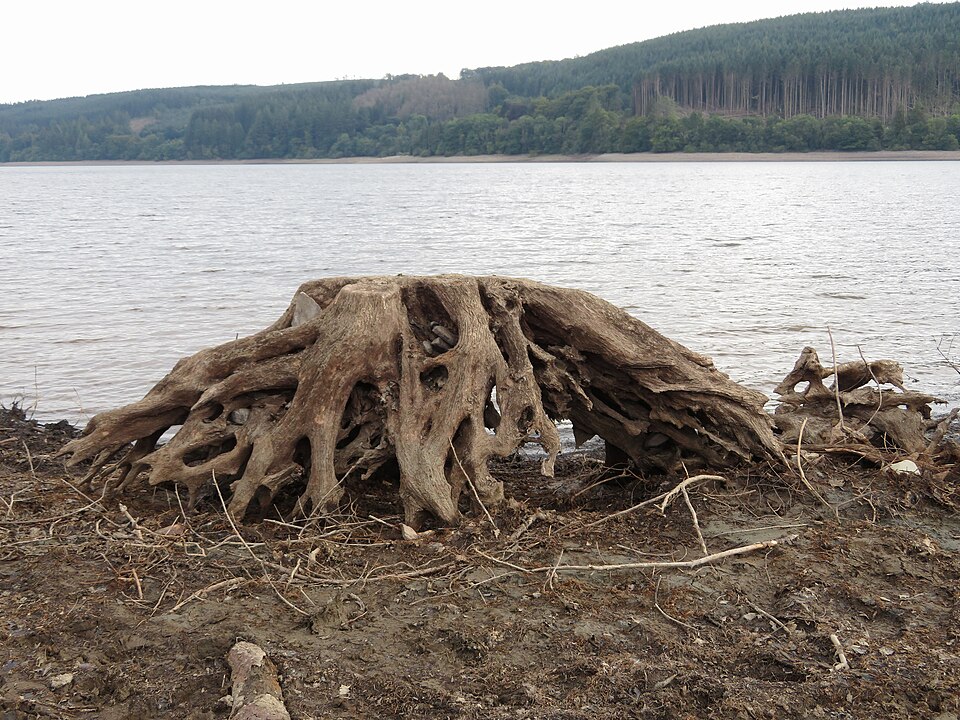
The old village is not entirely gone. In the drought of 2022 the water fell far enough to show the foundations of old buildings, dry-stone walls and the line of the old road, as well as a bridge. Reports said this was the first time the remains had been seen since 1976. Later that year the old Llanwddyn bridge, Pont Cedig, was seen at the head of the lake.
The story has also reached literature. In W. G. Sebald’s 2001 novel Austerlitz, the central character is haunted by his idea of the drowned village after being shown the reservoir by his adoptive father, who was born there. The straining tower and the dam are both Grade I listed.
Sources and credits
Every figure on this page is sourced. Every photograph is credited.
- Wikipedia, Llanwddyn; Lake Vyrnwy; Lake Vyrnwy Straining Tower
- Lake Vyrnwy Tourism, History of Lake Vyrnwy
- People’s Collection Wales, Reservoirs of Wales
- Cadw listing, Lake Vyrnwy Dam; Memorial Obelisk to Lake Vyrnwy Workers
- Coflein, Llanwddyn village; St Wddyn’s Church; Lake Vyrnwy Dam
- Grace’s Guide, Vyrnwy Waterworks
- Afonydd Cymru, Afon Efyrnwy
- Daily Post, the lost Welsh village
- Shropshire Star, low water reveals the hidden village (August 2022); old bridge resurfaces (October 2022)
- Gilkes, Hydro Hall of Fame: Lake Vyrnwy
- Mysterious Britain, the Lake Vyrnwy obelisk
- Hafren Dyfrdwy, Lake Vyrnwy visitor information
Photographs
- The straining tower, 2009: Clausgroi, via Wikimedia Commons, CC BY-SA 3.0.
- The dam under construction, about 1885: John Thomas, National Library of Wales, via Wikimedia Commons, public domain.
- An old tree stump exposed in the drought, September 2022: Gareth James, via Wikimedia Commons, CC BY-SA 2.0.